Shortly before Mozart’s librettist Lorenzo Da Ponte was exiled from Venice either for cavorting with a married woman while serving as a priest (if you believe the authorities), or for writing poetry that celebrated a radical political candidate (if you believe him), Da Ponte broke up a fight between his mistress and three other women who had been his lovers. Depending once again on whom you trust, the three women descended upon Angioletta Bellaudi with knives, or they descended upon Angioletta Bellaudi without knives, and Da Ponte swooped in with his own knife and injured one of the assailants. Either way, the fight is alleged to have begun because both Angioletta and Da Ponte had their own lovers while they were together. Lorenzo, the story goes, was not troubled by his mistress keeping other men, but she was rabidly jealous of his. How totally Don Giovanni is that story? Envious lovers. Retributive violence. A libertine punished by the consequences of his own misdeeds.
The tale would seem to make clear from whence came the imagination that brought us the adventures of the serial seducer Don Giovanni: from personal experience. Unless it’s simply not true. The truth or falsity of the knife fight story is, like the opera itself, clouded in a mystery that allows for multiple interpretations. At least two of the biographies of Da Ponte, who is oft described as a “libertine” “adventurer,” but is said by some scholars to be neither, feature this harrowing anecdote. However, the anecdote is unsourced in both biographies, and absent from other (more reliable) biographies. How did it emerge?
Biographers Anthony Holden and Sheila Hodges don’t say, but in both books it appears in the context of testimony against him in the trial that ended in his banishment. This may mean the anecdote comes to us from Da Ponte’s enemies. Or perhaps he made the story up. Some of the editors of the various editions of his action-packed Memoirs say he was inclined to tall tales. Scholar Felicity Baker, though, from whom we’ll hear more later, says this skepticism of Da Ponte’s stories originated because one of his editors in the early 20th Century (Fausto Nicolini) was an anti-Semite, and Da Ponte was a converted Jew. The anecdote has much to tell us about who Da Ponte was, and therefore who Don Giovanni is. Was the author a Don Juan with multiple women at the same time? Or, is biographer Rodney Bolt right that he was never really a Don Giovanni type of lover; that he was instead always falling in love? We’ve been arguing for almost 240 years whether Don Giovanni is a hero, an anti-hero, or a villain. Who Da Ponte was has bearing on which interpretation is accurate.
To our own era, only a little shy of a decade after the #MeToo movement began, it would seem clear that Don Giovanni (the Italian equivalent of Don Juan) is a villain. Not one but two major opera companies (the Royal Opera of London and the Lyric Opera of Chicago) led their new seasons this month by staging Mozart and Da Ponte’s semi-comic tale as one of rape, murder and retributive justice. Oddly both season debuts are revivals of productions from 2014, before #MeToo dropped, but the sensibility of the era is already visible. The Metropolitan Opera debuted a specifically post-#MeToo version in 2023, which was a big change from its production before the opera house was hit by the wave of scandals, and which depicts Giovanni even more clearly than Chicago and London as an evildoer. The scandals of the #MeToo era have made the opera more relevant, but paradoxically the last decade has also seen the debate in the scholarship over the correct interpretation of Giovanni turbocharged, with not one but at least three books arguing the Don should not be represented merely as a typical #MeToo predator villain. A fourth book out this April, Martha Nussbaum’s The Republic of Love: Opera & Political Freedom, firmly argues the opposite. The debate reflects a continued uncertainty about who Don Giovanni is that is best answered in part by examining who Lorenzo Da Ponte is.
Who is Don Giovanni?
Shortly after the beginning of director Robert Falls’ Don Giovanni at Lyric Opera of Chicago this month, the title character bursts onto the stage handcuffed to Donna Anna, the latest of his literally 2,065 sexual conquests. We have heard them engaged in what can ambiguously be called violent lovemaking. Within a few moments he is on top of her, threateningly. In his director’s notes, Falls describes the incident as an “attempted sexual assault.” This gives the earliest lines of the opera a distinctly different tint than the Royal Opera production, in which she seems to be pursuing Giovanni not to bring him to justice but to stay with him a few moments longer.
DONNA ANNA
No, you won’t, you shan’t escape me! I will never let you go!
DON GIOVANNI
Do not scream! You’ll wake the household. Kiss me, dear, and let me go!
The libretto itself (quoted here from a version by W.H. Auden and Chester Kallman, as I lack the Lyric’s and Royal Opera’s uncredited translations) is not strictly clear, it has been pointed out by Baker, whether Don Giovanni has tried to rape her, whether she’s pursuing him because she loves him, or some other reason. Leporello, Giovanni’s servant, will in a few moments describe the incident with an Italian word that clearly means rape (“sforza”), but the audience has just seen that he is not in a position to know for sure what happened. Still, it is clear enough in Falls’ production.
What we know for sure is that her father, the Commendatore, steps in to defend her honor:
COMMENDATORE
Where is the villain? Draw, sir, and fight me!
DON GIOVANNI
No! Pride forbids me to draw on graybeards.
The action continues that way for several lines until Giovanni gives in.
DON GIOVANNI
On guard then! Your death is near.
The stage directions tell us very little about what happens next. They say only: “Si battono;” “They fight.” And then: “Il Commendatore è ferito.” “The Commendatore is wounded.”
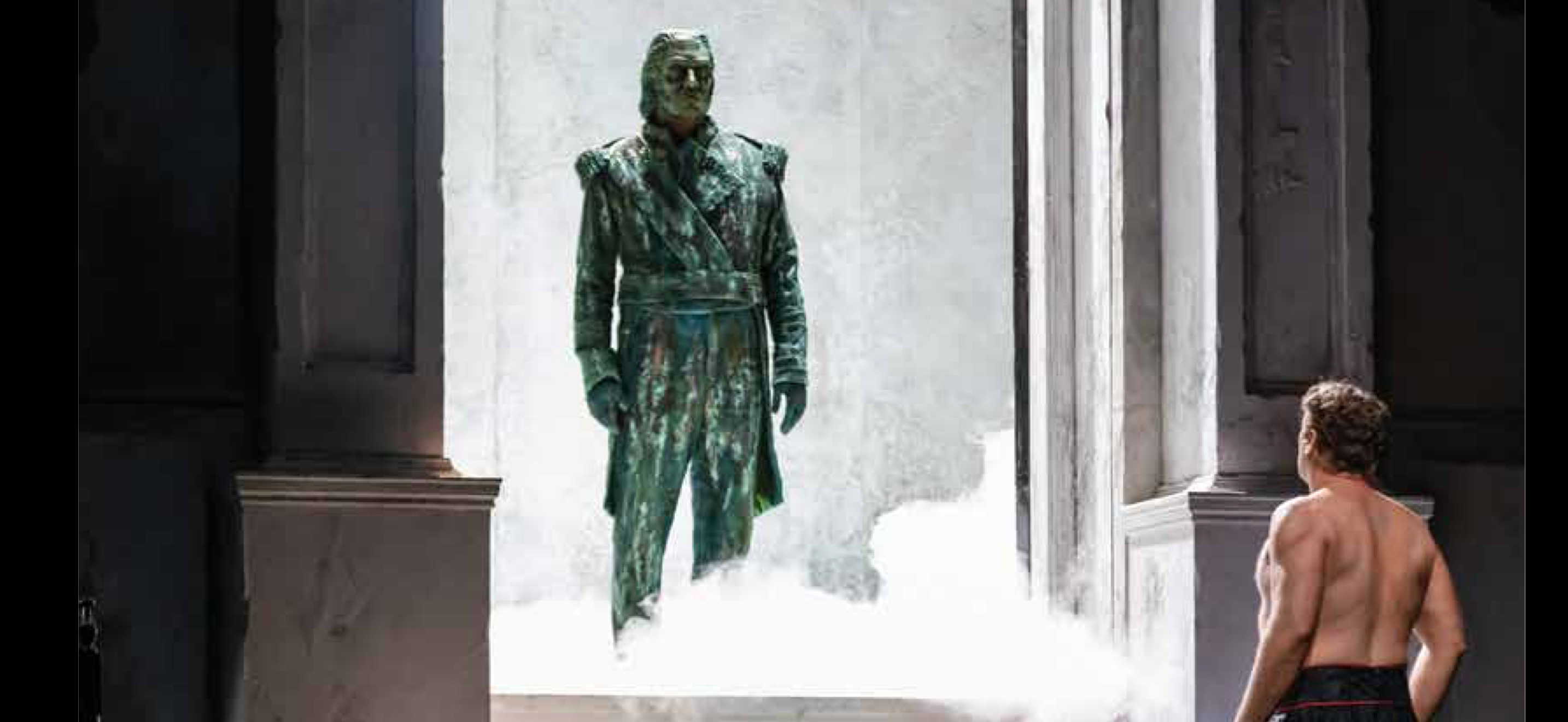
In most productions of the opera, this scuffle takes place with swords. That necessarily humanizes Don Giovanni, because when one is forced into a sword fight, one must fight back or die. The mortal wounding of the Commendatore in such a production is much more likely to read as self-defense, and therefore when he dies of the wound it is often not technically murder. But in two productions that ran after the advent of the #MeToo movement, Don Giovanni does not get drawn into a sword fight. He shoots the Commendatore in cold blood. In the Falls production, when her father appears to rescue her and defend her honor, Giovanni wrests a gun from his hands and (though the Commendatore is left defenseless) shoots him. Meanwhile, in 2023 the Metropolitan Opera introduced a production in which the father threatens the Don only with fisticuffs. (The production ran first in Paris in 2019.) Giovanni nonetheless answers his assailant by pulling out his own gun and firing at point blank. In the Royal Opera production, the combatants are still using swords, which by comparison seems quaintly pre-#MeToo. But it’s clear the London production does not see Giovanni as a hero.
The debate rages in critical literature
Since the #MeToo movement began in 2017 to force a reckoning with the perpetrators of rape and other sexual crimes, it has become some version of impossible for an opera company to mount an interpretation of Giovanni as hero. “If nineteenth century audiences (or at any rate their male members) viewed this behavior indulgently, surely audiences today cannot,” writes University of Chicago professor and philosopher Martha Nussbaum in an essay in her new book The Republic of Love. A version of her essay appears in the program of the Lyric’s new Don Giovanni. Not that there haven’t been post-#MeToo writers who have tried to articulate a view of Giovanni as heroic. In his 2018 book Opera as Opera, Conrad L. Osborne describes the Don as a “scoundrel hero.” “Not anti-hero,” he clarifies, “but hero: among the men of the audience he arouses envy; among the women he arouses arousal.” In a footnote to this remark he adds, “Contemporary women forthright enough to confirm this would include Marthe Keller, the fine actress who directed the most recent Met production of Don Giovanni, and the philosopher Julia Kristeva. I doubt that either can be accused of counterfeminist softheadedness.” Were this the sort of book to attract attention, and not 800 pages of (mostly fascinating if uniformly conservative) self-published criticism, perhaps Osborne would have faced some form of cancelation for remarks like those.
Additionally, not one but two books published after #MeToo argue in their very theses that Giovanni is rightly viewed as a hero. In 2022’s The Original Portrayal of Don Giovanni, author Magnus Tessing Schneider argues that the first production of the opera in 1787 portrayed the Don as a “charming, nonviolent seducer.” The book acknowledges a heavy debt to 2021’s Don Giovanni’s Reasons: Thoughts on a Masterpiece by Felicity Baker, which reproduces essays from prior years arguing that Mozart and Da Ponte intended Giovanni to be in some sense heroic despite what Baker identifies as a trend dating all the way back to the 1980s towards portraying him as a villain. Schneider describes the “instructive experience” of presenting an “admittedly provocative” paper at a conference in Stockholm in 2017 just before the beginning of the #MeToo movement, which received negative responses from several American scholars but positive ones from Swedish scholars. “While the #MeToo movement has spurred me to rethink some of my arguments,” Schneider wrote, “I still believe, like Felicity Baker, that a production of Don Giovanni that refrains from portraying the title hero as the stereotypical violent predator has more to offer today’s audiences than one that doesn’t.” Writing in 2010, though published in book form only after #MeToo and thereby sticking to her argument in changed times, Baker argues that “We must suppose that today’s opera directors’ insistence that the women are victims, even when the work is set in the twentieth or twenty-first century, speaks to a public deeply troubled by news of the prevalence of male violence against women around the world, and of its impunity.” She does not disagree with political campaigns to protect women in law: “Effective protection is a first necessity of course, but it does not make women free and equal. In that light, today’s productions are pessimistic. But they are also deeply regressive, in comparison with the political audacity of the Mozartian seducer who seeks to give women an experience of sexual pleasure.” Indeed, Baker says the opera “defends women’s rights much more subversively than” Da Ponte and Mozart’s other two collaborations, The Marriage of Figaro and Così Fan Tutte.
This particular message in favor of happiness and freedom was ripe for its moment when the opera debuted in 1787, just before the French Revolution, Baker argues. “In the Late Enlightenment and soon after the American Declaration of Independence stressed individual rights and the right of revolution (1776), which we know as the European pre-Revolutionary moment, this time was ripe for an opera about the human right to happiness, represented as a young man’s passionate love of pleasure and liberty—and exposing the injustice of his punishment by a painful death.”
Nussbaum, by contrast, calls the ending a happy one. Likewise, Falls does not critique the painful death Da Ponte creates for his Don Giovanni. He celebrates it. In what is the most dramatic of all the endings I’ve seen in productions of the opera, Falls’ Don Giovanni clings desperately to a table as the ghost of the Commendatore lifts it at an angle. The Don struggles not to fall into a smoking pit that has suddenly opened beneath him. (My 90-plus-year-old father turned to me when that happened and said, of Don Giovanni, “That must be the villain.”) Once Giovanni is damned to hell, the houselights go up unexpectedly as the cast of surviving characters (all of whom feel betrayed by the Don) sing gleefully, “The wages of sin are death.” Leporello even points into the audience, making it clear if the houselights did not that the audience is implicated. Falls refuses to let us spectators off. The Royal Opera production ends perhaps less punitively: Don Giovanni does not, for once, descend into hell at all. But he is left starkly alone, perhaps raving at the sky. For Baker, under this post-1980 endorsement of the punishment of Don Giovanni, “the rapist’s role implies no difference from our modern nightmare of rapist-murderers. So there is no argumentation for the public to think about.” And she adds, no one needs another message that “‘if you’re bad you’ll go to hell.’”
Interestingly, though her essay appears in the program at the Lyric, Nussbaum does not share Falls’ apparent glee at the punishment of the Don. While she sides unequivocally with an interpretation of Giovanni as villain, she notes that literally all of Mozart’s six other operas in the regular repertoire emphasize almost an obsession with forgiveness as opposed to punishment, from Idomeneo (who is granted a reprieve from judgment by a deus ex machina in the guise of the god Neptune) to The Clemency of Titus (the title of which speaks for itself). In a sharp analysis, she also notes that each of the three women Don Giovanni seduces in the opera is given an aria in which they call for revenge and then back off, whether to sing the praises of another lover, or once again of Giovanni himself.
Getting back to Da Ponte
How did Da Ponte feel about this ending? Was he attempting to criticize the puritanical community obsessed with a feudal honor code which seeks out Giovanni and tries to kill him? Da Ponte is often a sort of invisible partner to Mozart, who gets credit for “writing” his operas even when the credit is clearly due to the wordsmith. In the strangely unintellectual film Interlude in Prague, for example, Mozart is given full credit for having written Don Giovanni based upon his own sexual affairs and Da Ponte is completely written out. But to unravel the mystery of Don Giovanni, we need to understand who Da Ponte was himself. Anthony Holden calls Da Ponte a libertine. Felicity Baker says he is not a libertine, “although everyone today seems to assume that he was.” Martha Nussbaum says the confusion about whether he is a libertine often leads to a Don-positive interpretation. “Commentators have sometimes been misled by DaPonte’s self-proclaimed profligacy in his Memoirs into thinking that he must have written a pro-Don libretto; but he didn’t,” Nussbaum says. “He was clearly capable of creating characters of many different types.”
It is true that Da Ponte, who ended his career as Columbia University’s first professor of Italian literature in New York, sometimes talks rather like Don Giovanni: “At this juncture,” Da Ponte boasts in his memoirs of the moment before he was thrown out of Venice, “I was loved of women, esteemed of men, blandished by patrons. The future lay bright before me.” And he was indisputably friendly with the famous seduction artist Giacomo Casanova, who is said to have been an influence on the character of Don Giovanni. But, Bolt argues, he was a lover of one woman after another, and not an abuser of many at once. Writing about Angioletta Bellaudi, the woman who allegedly provoked the knife fight, Bolt reflects in his book The Librettist of Venice: “Here was no Don Giovanni, but a man devoted to one woman alone, who was forbidden to have her, and who went to extraordinary lengths to hang on to her.” So maybe he was critical of Don Giovanni after all.
Politically and philosophically, though, Da Ponte was in sympathy with the spirit of the writings of Jean-Jacques Rousseau, which helped inspire the French Revolution. Da Ponte would probably not have been banned from Venice in 1779 had he not first been banned from teaching in Venice in 1776. It galled the authorities that this young poet continued to teach, specifically as a tutor for the children of a radical political candidate who ended up arrested and jailed not long after the future librettist was expelled. Da Ponte was banned from teaching specifically for writing poetry that aped Rousseau. Having been assigned to write poetry on a particular topic, “the one I chose that year was, in my misfortune, the following,” Da Ponte writes in the Memoirs: “Whether mankind had attained happiness by uniting in a social system, or could be considered happier in a simple state of nature.” This was a very Rousseauian line of thought, the sort of thinking that influenced revolutionary thinkers in the Enlightenment and their notion of inalienable rights that supersede manmade laws. While Da Ponte examined the question by alternating in his poetry from the pro position to the con position, he clearly wrote with more enthusiasm for Rousseau’s argument: That man was happier before laws emerged. Don Giovanni, as Baker points out, is just the sort of man who is happier in a state of pre-law nature than under the strictures of a society.
Ultimately, though, if one isn’t convinced by productions’ depictions of rape and murder that Don Giovanni is a villain, the terrible way he treats his servant might persuade. The opera opens with the plight of servant Leporello: “On the go from morn till night, running errands, never free, hardly time to snatch a bite, this is not the life for me. I would like to play the master, would no more a servant be.” This depiction of ambivalent servanthood picks up where The Marriage of Figaro left off, with its controversial examination of the life of the servant who is smarter than his bosses. From the beginning of the opera through to its final moments, when Giovanni guzzles food and denies more than a morsel to his servant, the libretto shows a particular concern for Leporello’s interests that can get lost in the emphasis on sexual politics. Leporello is the closest in class station to Da Ponte and Mozart, as Baker argues, and Da Ponte’s relationship to the character (however multi-sided this delightful comic character is) feels less ambivalent than that of Don Giovanni.
In the end, I perceived Da Ponte, however trustworthy the Memoirs are, as in a kind of wistful sympathy with the Don, whom he knows he must punish in the end. Perhaps the myriad interpretations that have sprung from his work are entirely intentional. It’s a Shakespearean approach to writing more than a #MeToo-era approach: The villains are multi-dimensional and often even sympathetic, not cartoons worthy of eternal condemnation. Even the Met, which made the most committedly post-#MeToo Giovanni in the 2022-23 season, says in its publicity materials for that production that “the opera offers countless interpretations for any director willing to take it on.” In a way, that’s a bold statement for a production that in an interview during the Met in HD broadcast hung its hat on its particular translation of Da Ponte’s subtitle, Il dissolute punito: Often translated as “The Rake Punished” or “The Libertine Punished,” the Met’s director Ivo van Hove translated it pointedly as “The Criminal Punished.” He argued that Mozart saw Don Giovanni as “an abuser.” But prior Met productions in the era of #MeToo-accused James Levine and Placido Domingo did not lead the opera with a cold-blooded murder; they had a morally ambiguous, forced swordfight. Don Giovanni has become less sympathetic than ever in the post-#MeToo era. It’s right that the tale should be reinterpreted for each era: Given Da Ponte’s pointed ambiguity, I suspect that’s just what he intended.